

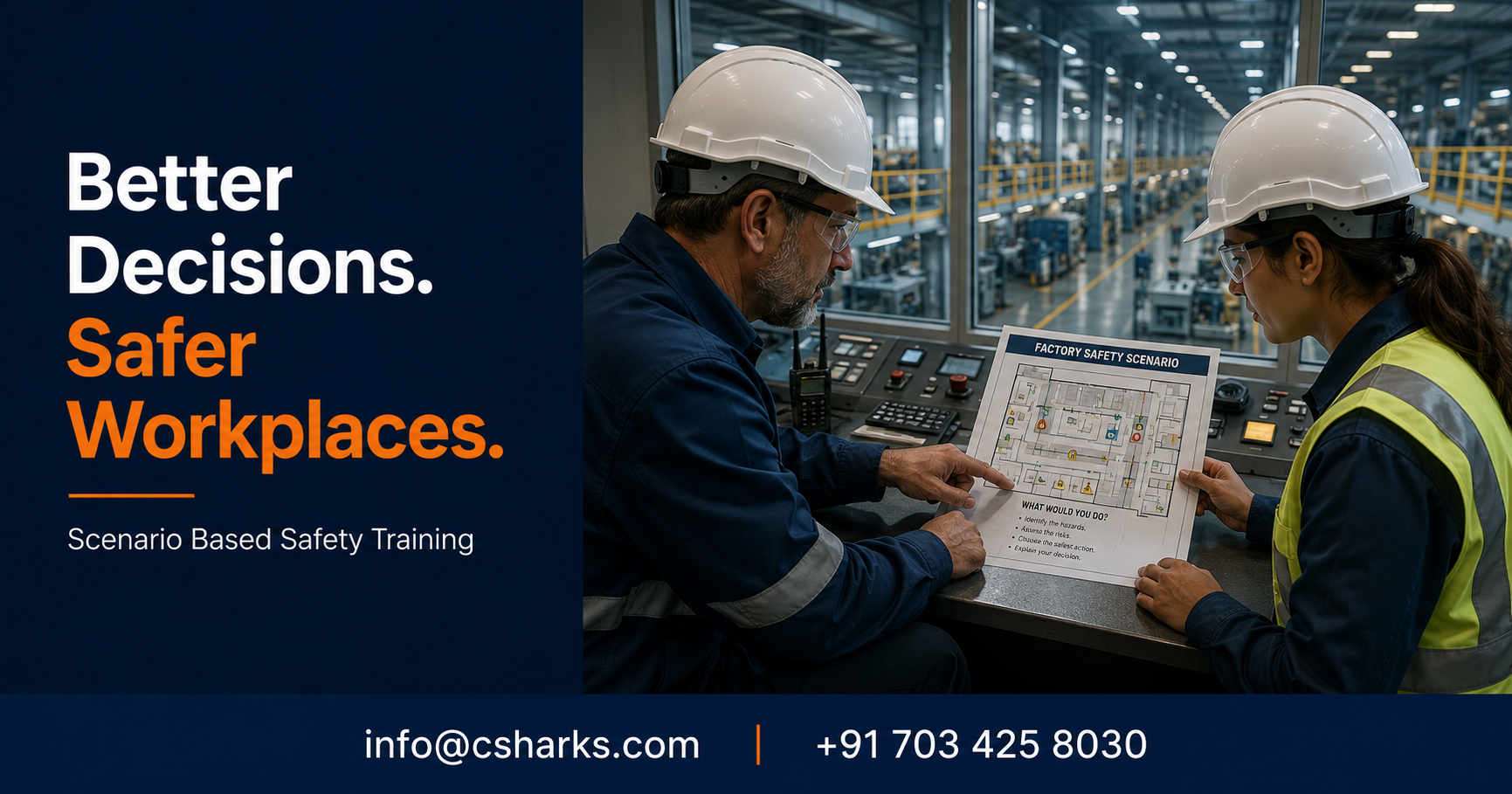
Employees may know the correct safety procedures, but can they apply them when a real workplace risk appears?
Traditional workplace safety training is useful for explaining policies, hazards and standard operating procedures. However, employees also need opportunities to practise using that knowledge.
Scenario based training places employees inside realistic workplace situations. They must identify hazards, make decisions and experience the consequences of their choices in a controlled environment.
This helps organisations move beyond course completion and develop employees who are better prepared to respond when safety matters most.
What Is Scenario Based Training?
Scenario based training is an interactive learning method built around situations employees could encounter at work.
Instead of only reading instructions or watching a safety video, employees are shown a problem and asked what they would do next.
A factory worker, for example, might enter a simulated production area and notice:
- A missing machine guard
- A liquid spill near electrical equipment
- An obstructed emergency exit
- A colleague without the correct protective equipment
The employee must identify the risks, select an action and receive feedback based on that decision. This makes employee safety training more practical because learners apply their knowledge rather than simply memorising information.
Why Traditional Safety Training May Not Be Enough
Presentations, videos and manuals remain important parts of a safety training program. They communicate policies, procedures and regulatory requirements.
The challenge is that these methods are usually passive. An employee may complete a training module and pass an assessment without demonstrating how they would respond to a complex or unexpected workplace situation.
OSHA states that safety education should give workers the knowledge and skills required to work safely, identify workplace hazards and understand how those hazards can be controlled.
Scenario based safety training supports this objective by giving employees realistic opportunities to practise making decisions.
Four Ways Scenario Based Training Improves Safety Decisions
Strengthens hazard recognition
Employees practise spotting risks within realistic factories, warehouses, construction sites and maintenance areas.
Creates safe practice
Teams can rehearse dangerous or disruptive situations without putting employees, equipment or operations at risk.
Connects SOPs with decisions
Learners understand when a procedure applies, what action comes first and when an activity should stop.
Measures readiness
Safety teams can review hazard recognition, decision accuracy, response time, attempts and repeated mistakes.
OSHA also provides an interactive, game based training tool designed to help workers understand the process of identifying workplace hazards.
A Practical Scenario Based Training Example
Consider a working at height training scenario. An employee is preparing to carry out maintenance on an elevated platform and must inspect the environment before beginning.
- An unverified anchor point
- Unsecured tools
- Workers passing below
- Changing weather conditions
The employee must decide whether to begin work, correct the hazards or report the situation. Each choice produces an outcome. At the end, the employee receives feedback covering hazards identified, decisions made and areas requiring more practice.
This provides a stronger indication of safety readiness than simply asking the employee to recall a list of rules.
How Gamification Supports Scenario Based Learning
Gamification introduces challenges, progress, rewards and feedback into the learning experience.
In industrial safety training, employees might complete a hazard identification mission, follow the correct equipment shutdown sequence or respond to a simulated emergency.
The purpose is not to make serious safety risks feel like entertainment. It is to encourage active participation, repeated practice and improvement.
- Realistic missions and decision points
- Immediate, explanatory feedback
- Progress indicators and performance scores
- Opportunities to retry and improve
Employees progress by demonstrating safe decisions rather than clicking through content.
How to Introduce Scenario Based Safety Training
Organisations do not need to transform their complete safety training program at once. A practical approach is to begin with one important scenario.
Choose a situation that is high risk, difficult to practise physically, commonly misunderstood or connected to recurring incidents and near misses.
The scenario should use realistic workplace conditions and focus on decisions employees are expected to make. Existing SOPs, safety presentations, incident examples and training videos can be used as source material.
Digital scenarios should complement the wider safety program. Some activities will still require physical demonstrations, supervised practice or competency assessments.
Frequently Asked Questions
What is scenario based safety training?
It is an interactive training method that presents employees with realistic workplace situations. Employees identify hazards, make decisions and receive feedback based on their choices.
How does it improve workplace safety?
It helps employees practise applying safety knowledge before facing similar situations at work. It can improve hazard recognition, decision making and emergency preparedness.
Can existing safety content be gamified?
Yes. Existing SOPs, presentations, videos and incident examples can be transformed into interactive challenges, decision paths and safety missions.
Can scenario based training replace practical training?
Not completely. It can strengthen knowledge and decision making, but some tasks still require physical demonstrations, supervised practice and formal competency assessments.
Turn Safety Knowledge Into Better Decisions
Csharks develops customised gamified and scenario based training solutions for industrial safety, operational learning and workforce readiness.
Explore Industrial Training SolutionsContact info@csharks.com or call +91 703 425 8030